Welcome to our new website! We're still in the process of making updates and improvements, so please stay with us.
- Home

- News & Events
- Financing Africa’s Development: The Role of Reform...


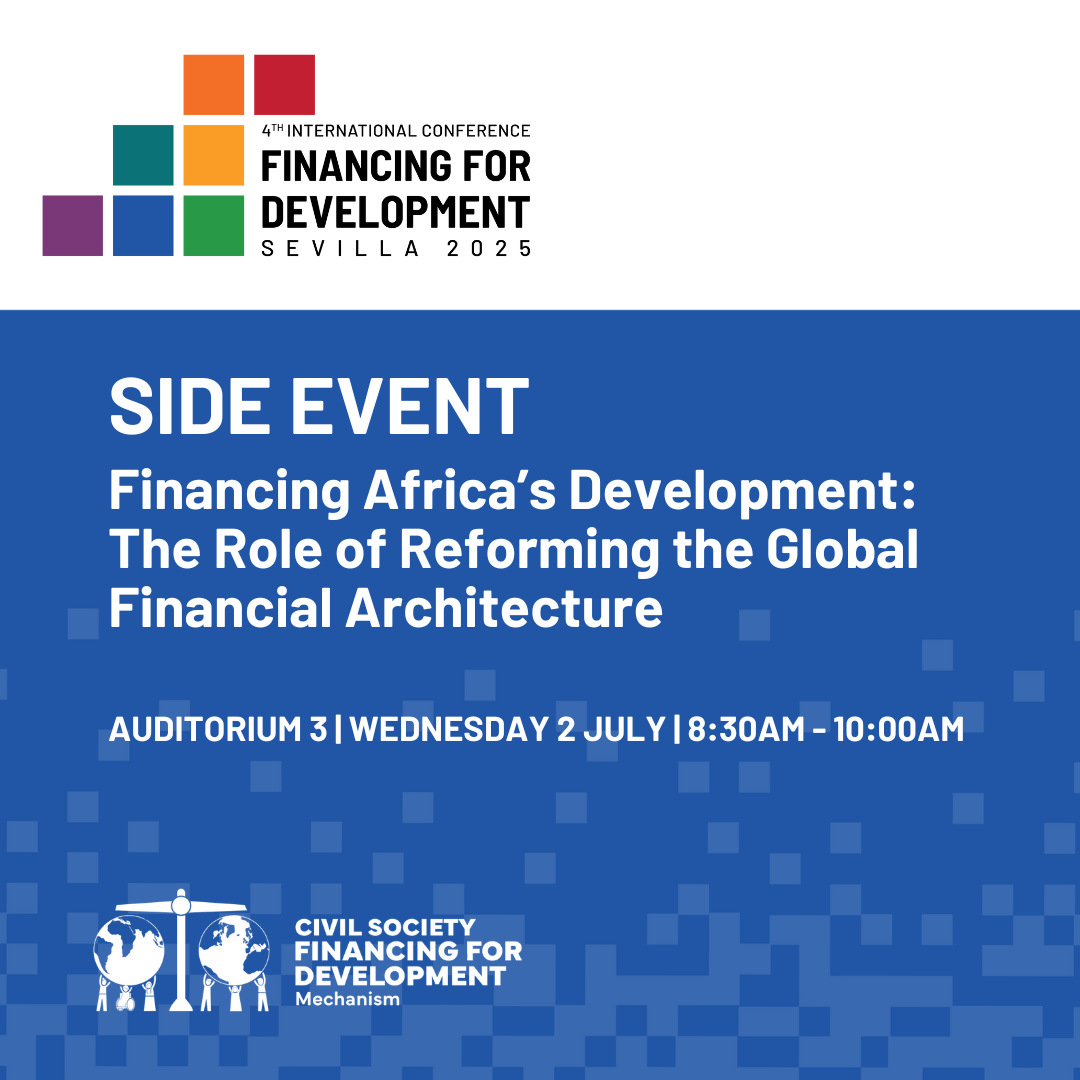
Financing Africa’s Development: The Role of Reforming the Global Financial Architecture
AUDITORIUM 3 | WEDNESDAY 2 JULY | 8:30AM - 10:00AM


Abstract
The international economic order has changed significantly since the last Financing for Development conference was held in 2015. In the African context, financing for development has become even more crucial. The cost of achieving the sustainable development goals by 2030 in Africa is estimated at about $1.3 trillion annually and around $234.5 billion–$250 billion to finance climate action. Failure to effectively scale up financing for this has dire consequences for the continent. While immediate action is necessary for Africa, this urgency is not being reflected in global processes and the importance of reforming global financial architecture to advance Africa’s transformation is constantly understated. Several changes need to take place in order to reform the global financial architecture. These include not only changing the rules but also the structures of the institutions involved in the world economic order.
The side event aims to discuss key priorities on reforming the global financial architecture and their importance in promoting sustainable development in Africa, and contribute to building consensus on a common African position and a roadmap for action beyond the FFD4 conference.
Description
Context
The 4th International Conference on Financing for Development (FfD4) is a Member State-led process where governments, alongside other stakeholders, come together to develop a framework for financing sustainable development. There have been three such conferences in the past, each resulting in an outcome document that provided a framework for financing for development. Previous outcome documents included the Monterrey Consensus of 2002, the Doha Declaration of 2008 and the Addis Ababa Action Agenda of 2015. In 2025, the fourth conference will take place in Seville, Spain.
The international economic order has changed significantly since the last Financing for Development conference was held in 2015. In the midst of overlapping crises such as the COVID-19 pandemic, the increasing effects of climate change, and the impact of conflicts in Russia–Ukraine, Sudan and the DRC, the global economic landscape has significantly altered.
Scaling up financing for development
In the African context, financing for development has become even more crucial. The cost of achieving the sustainable development goals by 2030 in Africa is estimated at about $1.3 trillion annually and around $234.5 billion–$250 billion to finance climate action.[1] Failure to effectively scale up financing for this has dire consequences for the continent. Within the context of climate change, Africa is the most climate-vulnerable continent despite contributing the least to greenhouse gas emissions. Africa is energy-poor. Approximately 600 million people in Africa do not have access to electricity and 970 million lack access to renewable and clean cooking fuel and still rely on biomass for cooking. Unless changes are initiated, by 2030 some 90% of people without energy access will be Africans. Agriculture is one of the most climate-vulnerable sectors within the continent and is increasingly negatively impacted by climate change. This has a severe impact on food security in Africa and prospects for structural transformation. The Food and Agriculture Organization (FAO) estimated that in 2022, 868 million Africans experienced food insecurity.[2]
Undoubtedly, immediate action is needed for Africa’s structural transformation to take place. However, the continent continues to face challenges. Africa’s median public debt ratio has been on an upward trajectory since the beginning of this decade, increasing from 54.5% of GDP in 2019 to 64% in 2020, and hovering around 63.5% between 2021 and 2023 (Africa Economic Outlook, 2024). In addition, the flow of FDI, ODA, portfolio investments and remittances dropped by 19.4 % in 2022. With high debt servicing costs, and strained tax capacities as evidenced by a median of a tax to GDP ratio of 14% in Africa, the region is experiencing constrained fiscal space which is crowding out financing investments in the economy and critical public services such as health and education.[3] This keeps African countries in a vicious cycle of underdevelopment and debt.
Failure of the global financial architecture to deliver change
Immediate action is necessary for Africa. However, this urgency is not being reflected in global processes. The 4thInternational Conference on Financing for Development is taking place against the background of a disappointing COP29 in Baku, Azerbaijan. Developing countries hoped to get a financial commitment of at least US$1.3 trillion per year by 2035 from developed countries with a substantial portion provided through public finance sources. However, the final negotiations of the New Collective Quantified Goal (NCQG), culminated to just US$300 billion per year until 2035.[4]This highlights one of the key problems with the current international financial architecture, the reluctance to make concrete commitments and the failure to deliver on existing commitments.[5] This is not only illustrated in climate finance but also in ODA commitments.
Another failure is the systemic imbalances that exist within the international financial architecture. International financial institutions such as the Bretton Wood institutions continue to dominate, leading to a creditor–centric global system. In 2021, for instance, of the $650 billion in SDRs issued by the IMF Africa received just $33 billion. [6] The increasing appreciation of the dollar due to tightened US monetary policies has had the effect of increasing the cost of debt servicing for many African countries, depletion of foreign reserves in Africa and the destabilisation of local currencies.
The failure of the global system to address trade protectionism, increasing unilateral measures and the regionalisation of supply chains has further hindered Africa’s structural system. This puts Africa’s regional attempts towards increased intra-African trade and overall, achieving a greater share of global trade at jeopardy.[7] Africa holds at least 30% of the world’s mineral reserves and a significant portion of transition minerals, yet the current trade policies have reduced the benefits of these reserves for Africa leading to Africa extracting only 40% of the potential revenue it could extract from this sector.
Taxation, while one of the most sustainable sources of finance, alone, will not be enough to finance Africa’s structural transformation. Hence, a reformed global financial system can be the basis for scaling up more affordable, predictable, accessible and adequate internal resources for sustainable development goals.
Way forward
Several changes need to take place in order to reform the global financial architecture. These include not only changing the rules but also the structures of the institutions involved in the world economic order. Some of these changes include:
1. Democratizing and increasing the inclusiveness of global finance institutions by shifting decision making power back to the United Nations
2. Establishing a debtor-centric global debt architecture
3. Increasing accountability on existing finance commitments and responsibilities
This side event seeks to unpack Africa’s key priorities for transforming the global financial architecture within the context of FfD4 proceedings and meeting the significant financing needs required for Africa’s sustainable development.
Objectives of the side event
1. Discuss key priorities on reforming the global financial architecture and their importance in promoting sustainable development in Africa
2. Building consensus on a common African position and developing a roadmap for action beyond the FFD4 conference.
[1] https://www.afdb.org/en/news-and-events/scaling-financing-key-accelerating-africas-structural-transformation-73244
[2] https://www.afdb.org/sites/default/files/news_documents/ader_2024_-_chapter_2_en.pdf
[3] https://www.afdb.org/en/knowledge/publications/african-economic-outlook
[4] COP29: Key outcomes agreed at the UN climate talks in Baku - Carbon Brief
[5] https://africanclimatefoundation.org/research-article/priorities-for-an-equitable-reform-of-the-global-financial-system/
[6] https://www.afdb.org/en/news-and-events/scaling-financing-key-accelerating-africas-structural-transformation-73244
[7] https://www.uneca.org/stories/africa%E2%80%99s-critical-mineral-resources%2C-a-boon-for-intra-african-trade-and-regional-integratio