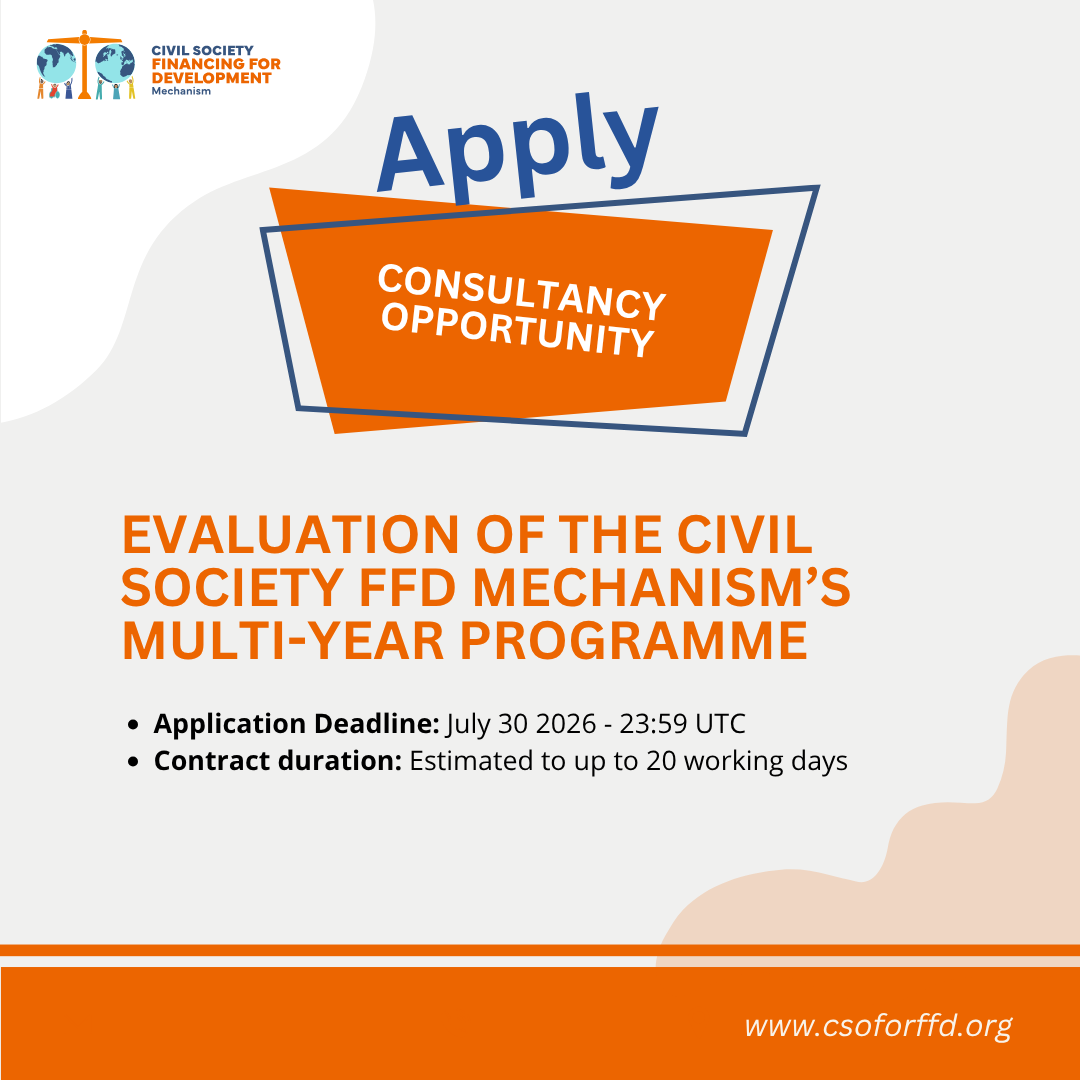
Evaluation of the Civil Society FfD Mechanism’s multiyear programme.
Deadline for Application – 31 July 2026
Background
The Financing for Development (FfD) process is centred around supporting the follow-up to the agreements and commitments reached during the four major international conferences on FfD: in Monterrey, Mexico in 2002; in Doha, Qatar in 2008; in Addis Ababa, Ethiopia in 2015; and in Sevilla, Spain in 2025. The process also follows up on FfD-related aspects of outcomes of major United Nations (UN) conferences and summits in the economic and social fields, including the 2030 Agenda and the Sustainable Development Goals (SDGs) (What is Financing for Sustainable Development? | Financing for Sustainable Development Office).
The engagement of civil society is noted in the Addis Abeba Action Agenda (AAAA), after which the Civil Society (CS) FfD Mechanism (initially referred to as CS FfD Group) [1] was established to promote and facilitate engagement of civil society in the FfD process. The CS FfD Mechanism is currently an open list of more than 800 organizations and over 1000 individuals.
The Government of Norway (though Norad) has supported the CS FfD Mechanism since 2020. The first agreement, signed 20.11.2020, amounted to NOK 16 million [2], and an amendment, signed 06.11.2024, provided additional NOK 15 million. Norad’s agreement partner is Society for International Development (SID), the CS FfD Mechanism’s fiscal agent.
The CS FfD Mechanism advocates for global systemic reforms that promote the following developmental outcomes:
Expand the policy and fiscal space of developing countries to advance the agendas for socio-economic transformation and sustainable development (Agenda 2030).
Democratize global economic governance by shifting its barycentre towards a strengthened role of UN, including newly established institutions.
Strengthen the centrality of human-rights, gender equality as well as social and climate justice as normative foundations for renewing the current economic policy frameworks.
In order to strengthen the capacity and impact of the CS FfD Mechanism, the following result framework was defined.
Impact: The CS FfD Mechanism promotes, catalyses and facilitates effective collective engagement of civil society in the formal FfD process and all its related spaces.
Outcome 1: Democratic accountability of the FfD process reinforced with a special focus of participation of Southern constituencies.
Outcome 2: Year-round follow-up from civil society on key thematic areas of focus for the FfD strengthened.
Outcome 3: Civil society capacity to engage in economic justice and Agenda 2030 at national, regional and international level enhanced
Outcome 4: Advocacy and communication tools for global, regional and local action strengthened and disseminated among participating organizations [3].
Purpose of the evaluation, review questions and scope
As part of Norad’s management of cooperation agreements, evaluations should be conducted periodically. According to the grant agreement between Norad and the SID, an end-evaluation of the program focusing on results achieved should be carried out. The evaluation should respond to the need for learning, meet accountability purposes and provide input to decision related to further Norad support beyond 2026. This evaluation shall cover the period from 2020 up to the latest available information. The evaluation shall provide information on the following aspects:
Impact & Effectiveness:
o To what extent have the outcomes in the agreement been achieved?
o What impact has the CS FfD Mechanism’s advocacy efforts led to?
o Which results can be traced to the CS FfD Mechanism?
o Were the advocacy positions of the CS FfD Mechanism well understood and acknowledged by UN member states?
o To what extent did the advocacy and communication tools developed by the CS FfD Mechanism increased civil society’s understanding of and engagement in the FfD process?
o How can the CS FfD Mechanism’s impact be improved?
o Have the CS FfD Mechanism efforts led to any positive or negative unintended effects?
Legitimacy, Relevance and Coherence:
o Was the process where the CS FfD Mechanism defined their collective position legitimate and grounded in the developmental priorities of the Global South?
o What do stakeholders regard as the main strengths and weaknesses of the role taken by the CS FfD Mechanism?
o Have changes during the project period, affected legitimacy, relevance and coherence?
o Has the expansion of the CS FfD Mechanism affected its agenda and coherence?
o How did the CS FfD Mechanism manage its engagement in the recent FfD4 negotiations?
o How can the process to develop and articulate collective positions be improved?
o How is the CS FfD Mechanism perceived in its role and function by UN member states?
Capacity:
o Does the CS FfD Mechanism have the necessary capacity to fulfil its role in the FfD process?
o Has the CS FfD Mechanism increased civil society’s capacity to engage in the FfD-process?
o Was the spike of interest generated by the process towards FfD4 adequately handled by the CS FfD Mechanism’s coordination?
o Does SID have adequate capacity to handle the responsibility as Mechanism’s fiscal agent?
o Should the CS FfD Mechanism’s or SID’s capacity be strengthened and if so, how?
Efficiency & Sustainability:
o Have the CS FfD Mechanism’s resources been efficiently deployed towards meeting its objectives?
o Is the CS FfD Mechanism an efficient working modality towards achieving democratic accountability of the FfD process with a special focus of participation of Southern constituencies?
o Is the CS FfD Mechanism an efficient working modality towards enhancing civil society capacity to engage in economic justice and Agenda 2030 at national, regional and international level?
o Can any positive or negative unattended effects be observed? Examples might be increased sustainable capacity of participating organisations or sustainable alliances also outside the CS FfD Mechanism
o How can the CS FfD Mechanism increase the sustainability of its resource base?
Coordination and fiscal management:
o How effective is SID in its role as facilitator and fiscal agent of the CS FfD Mechanism?
o Are the financial management, accounting, reporting and administrative procedures efficiently and robustly conducted by SID?
o How can the facilitation process be improved?
Sources of information and methodology
The evaluation process will be conducted under the guidance of the Finance Oversight Committee of the CS FfD Mechanism, with support by the Facilitation Team and active involvement of the Coordination Group of the Mechanism.
To answer the questions, the evaluator can make use of various information sources, including desk review of documents, stakeholder interviews and surveys. The consultant(s) should, as a minimum, conduct interviews with representatives of the CS FfD Mechanism, representatives of other stakeholders external to the Mechanism, third party observers, donors and, to the extent possible, some representatives of UN member states that have been engaged by the CS FfD Mechanism’s advocacy.
The OECD/DAC quality standards for development evaluations should serve as a reference point for ensuring the quality of the evaluation processes and the report. Findings and conclusions should be backed by reference to evidence (source) and their magnitude/representativeness should be commented on. Routines for quality assurance; ethical standards (e.g. confidentiality of informants, sensitivity and respect to stakeholders, Do No Harm, Code of conduct etc.) should be adhered to.
Timeline and budget
The evaluation is expected to be conducted in the third quarter of the 2026 Fiscal Year with the following provisional schedule should apply:
Application Deadline & Confirmation of assignment: Applications by interested parties should be received by no later than July 31, 2026. Short-listed applicants will be interviewed within the following 2 weeks. Assuming applications meet the requirements, confirmation of assignment will be provided within the week of August 17, 2026, in consultation with the Finance Oversight Committee of the Civil Society FfD Mechanism.
Inception phase: Inception meeting to be held within 1 week of signing the contract. Inception report to be delivered within 1 week outlining the proposed methodology for review and approval within 1 week.
Assessment phase: Based on the agreed methodology, desk analysis, surveys and interviews will be conducted within a maximum period of 4 weeks.
Reporting phase: The evaluation shall result in a report (in English) that does not exceed 15 pages, not including annexes, and containing an executive summary not exceeding 2 pages with the main findings and conclusions. A draft report should be delivered by September 26th for review by SID, in consultation with the Finance Oversight Committee of the Civil Society FfD Mechanism, and feedback by October 9th. A final report should be delivered by October 20th, 2026.
Schedule adjustments: The final schedule may depend on the timing of the confirmation of assignment and will therefore be agreed at contracting stage.
Budget
The appraisal is subject to a procurement procedure where price is one of the award criteria. The others are relevant experience and proposed approach. The scope of the assignment is estimated to be twenty (20) working days maximum. Budget proposals exceeding EUR 8,500 will not be considered.
Required Expertise
The consultant is expected to have over 5 years of prior experience in assessment of civil society work and grant assessment as well thorough understanding of UN processes. Prior knowledge of the FfD-process as well as other global economic governance would also be appreciated. Consultants from the Global South are encouraged to apply. Drafting capacity in the English language is a prerequisite.
Proposal Submission Requirements
Interested and eligible consultants are required to submit their application in the English language with the following information:
1. Mandatory Requirements: Proposals will be considered only if the following mandatory requirements are provided:
A brief profile of the consultant (including his/her CV and portfolio) or brief profile of the firm/organization
Certificate of registration or incorporation for registered entities/firms or IDs for individual-based consultants
List of Directors, Shareholders, and beneficial owners (if applicable)
Tax Compliance
Valid business permit from the country of jurisdiction (if applicable)
Documentation of previous experience in similar assignments
2. The Technical Proposals, which must include:
3. The financial proposal, which must include:
The cost estimate for the service, broken down into the various components of the assignment
The financial proposal shall include all applicable taxes, quoted separately. If taxes are not mentioned in the financial proposal, SID shall consider them included in the prices provided.
The financial proposal shall be quoted in Euros.
The Mandatory Requirements and Technical Proposal can be submitted jointly while the Financial Proposal must be submitted separately.
All documents should be submitted by no later than 31 July 2026 at the following email address: procurement@sidint.org
Requests for information and clarification before applying can also be sent to procurement@sidint.org
Grounds for Exclusion
Organizations or individuals are to be excluded from participating in this Call for Proposals if:
They have been found guilty of grave professional misconduct and/or of involvement in corrupt or fraudulent procurement practices.
They have not fulfilled their obligations to pay taxes or social security contributions.
SID staff involved in the procurement process have a financial interest in, or close relatives who work with, the organization or individual.
They are involved in proceedings such as bankruptcy declarations, court-ordered winding up or administration, arrangements with creditors, or similar legal processes.
A court has convicted them of an offense related to their professional conduct.
Evaluation Criteria
Proposals will be assessed on:
Quality and coherence of methodology
Demonstrated understanding of the assignment
Relevant experience and expertise
Value for money
Standard Terms and Conditions
SID Employees: Please list all known SID employees and/or close relatives who have held a position or been engaged as a consultant in your organization within the past two years. Also, specify any SID employees or close relatives who own or control shares in your organization. If there are none, clearly state so.
Conflict of Interest: The Firm/Consultant must not employ any SID officer or employee to provide services under this agreement. The Firm/Consultant should ensure, to the best of their knowledge, that there are no actual or potential conflicts between their family, business, or financial interests and the services they provide. If private interests or services change, any questions about potential conflicts will be discussed with SID. Additionally, the Firm/Consultant must not report to an SID employee who is a near relative, and the near relative must not hold decision-making authority regarding the Consultant.
Ethics: The Firm/Consultant must exercise utmost care and diligence to avoid any actions or conditions that could conflict with SID’s best interests. During any agreement arising from the RFP, the Firm/Consultant shall not accept employment or undertake work that conflicts with SID or compromises the work under this RFP or related agreements. The Firm/Consultant and its employees are prohibited from offering gifts, entertainment, payments, loans, gratuities, or any consideration to SID employees, their families, other Consultants, subcontractors, or third parties to influence their actions against SID’s interests or for personal benefit. Any such violations must be reported to SID immediately upon identification.
Right to Reject or Modify: Selecting a proposal does not imply that all aspects of the proposal are acceptable to SID. SID reserves the right to negotiate modifications to the proposal’s terms and conditions before finalizing the contract to ensure a satisfactory procurement process.
Supplemental Terms and Conditions/Modifications: Any supplemental terms or conditions, or any modification or waiver of these terms and conditions, must be in writing and signed by the consultant/representative of the firm and SID.
Disclaimer: SID may terminate the RFP at any time without entering into a contract. SID reserves the right to accept or reject any or all applications and is not required to provide reasons for its decision. SID is also not obligated to award the procurement to the firm or consultant that offers the lowest price.
[1] In January 2023 the name was changed from the Civil Society FfD Group to Civil Society FfD Mechanism (CS FfD Mechanism) to reflect the open and inclusive nature of the platform as well as to signal its official and legitimate role as the civil society mechanism within the UN’s FdD process.
[2] A no-cost extension was signed 05.01.2023.
[3] The 4th Outcome is not included in the amendment of the agreement.
 Welcome to our new website! We're still in the process of making updates and improvements, so please stay with us.